


Building an Enterprise Knowledge Assistant: Benefits, Challenges and Best Practices
Every established organisation is sitting on a mountain of knowledge — policies, manuals, procedures, past project information, product details — usually scattered across drives, systems, and people's heads. The problem isn't that the knowledge doesn't exist; it's that nobody can find it quickly.
An enterprise knowledge assistant solves that. Staff ask a question in plain language and get a sourced answer drawn from approved company information, instead of hunting through folders or interrupting a colleague. It's one of the most useful and lowest-risk ways to start with AI — but building one well takes more than pointing a model at your files.
What an enterprise knowledge assistant does
At its core, it lets employees ask questions across your approved internal knowledge and get clear, sourced answers. Instead of "which document covers our returns policy?" followed by ten minutes of searching, someone asks the question and gets the answer with a link to the source. The key phrase is approved and sourced: it draws only on information it's meant to, and it shows where each answer came from.
The benefits
- Saves time. Staff stop hunting through systems and get answers in seconds.
- Unlocks institutional knowledge. Information trapped in documents and long-serving employees' heads becomes reachable.
- Consistent answers. Everyone gets the same, correct information rather than half-remembered versions.
- Fewer interruptions. Experts spend less time answering the same routine questions.
- A safe first AI project. Because it mostly reads and answers rather than taking actions, the risk is low.
How it stays accurate and trustworthy
Two design features make a knowledge assistant trustworthy. First, it grounds answers in your actual approved documents — retrieving the relevant, permitted information and answering from it — rather than making things up. Second, it cites its sources, so people can verify an answer instead of taking it on faith.
The quality of answers depends heavily on the quality and structure of the underlying knowledge. Well-organised, up-to-date content produces good answers; messy, contradictory, outdated content produces poor ones. This is why the source material matters as much as the technology.
Permissions are essential
A knowledge assistant must respect who is allowed to see what. It should enforce the same permissions as the rest of your systems, so it never surfaces a document to someone without access. Get this wrong and you've created a way to leak sensitive information through a helpful interface. Permission-aware retrieval isn't an optional feature; it's a requirement.
The real challenges
The honest difficulties are less about AI and more about your content and controls:
- Messy or scattered source data — the biggest task is often tidying and organising the knowledge the assistant will draw on.
- Enforcing permissions — making sure nothing is over-shared across teams or roles.
- Keeping content current — outdated documents produce outdated answers, so freshness matters.
- Setting expectations — it assists and informs; it doesn't replace judgement on complex matters.
Best practices for building one
Start with a well-defined body of knowledge rather than your entire estate — one department or topic where the content is reasonably good. Enforce permissions from day one. Insist on source citations. Keep a human in the loop for anything the assistant is uncertain about. And treat improving the underlying content as part of the project, not an afterthought. Prove it works in one area, then expand.
KBA Systems builds enterprise knowledge assistants on exactly this pattern — grounded in approved content, permission-aware, source-cited, and integrated with the systems where your knowledge already lives.
Frequently Asked Questions
What is an enterprise knowledge assistant?
It's an AI tool that lets employees ask questions in plain language across approved company information — policies, manuals, documents, project data — and get sourced answers, instead of hunting through folders and systems. It respects permissions and cites its sources.
Why is an enterprise knowledge assistant useful?
It saves staff time, makes institutional knowledge easy to reach, gives consistent answers, and reduces repetitive questions to experts. Because it mostly reads and answers rather than taking actions, it's one of the safer, higher-return AI starting points.
How does it keep answers accurate and trustworthy?
By grounding answers in your actual approved documents (retrieval), citing sources so people can verify, and respecting permissions so users only see what they're allowed to. Answer quality depends heavily on the quality and structure of the underlying knowledge.
What are the main challenges in building one?
Messy or scattered source data, enforcing permissions so nothing is over-shared, keeping content up to date, and setting expectations that it assists rather than replaces judgement. Tidying and organising the source knowledge is often the biggest task.
Does a knowledge assistant respect access permissions?
It must. A well-built assistant enforces the same permissions as the rest of your systems, so it never surfaces a document to someone without access. Permission-aware retrieval is a core requirement, not an add-on.
If your team wastes time hunting for information,
KBA Systems can help you build an enterprise knowledge assistant that answers questions across your approved documents — with the right permissions, source citations and integration into your existing systems.
Related Article
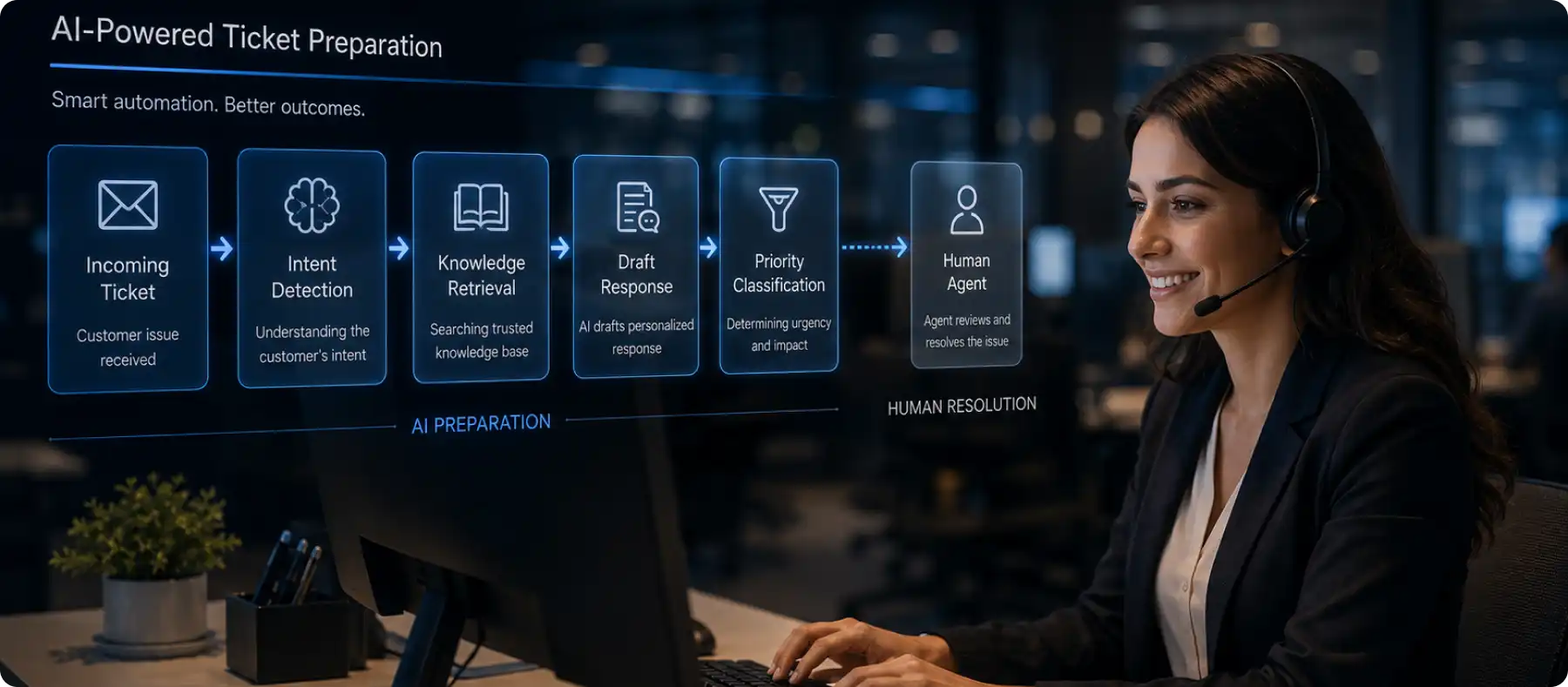
How AI Can Improve Customer Service Without Replacing Your Support Team
How AI can improve customer service without replacing your support team — triage, drafting, knowledge retrieval and where human agents stay essential.

Human-in-the-Loop AI: Why Businesses Should Never Automate Everything
Human-in-the-loop AI explained — why businesses should never automate everything, where human oversight matters most, and how to design review into AI systems.

Stop Building Apps. Start Architecting Intelligent Systems.
Whether you need to modernize legacy infrastructure or build custom AI agents from scratch, our elite engineering pods are ready to design your competitive edge. Let’s map out your transition.
