

AI Workflow Automation vs Traditional Automation: Which One Should You Choose?
"Should we use AI or traditional automation?" is a genuinely useful question — and the honest answer surprises people: a lot of the time, plain automation is the better choice. AI gets the attention, but it isn't always the right tool, and choosing it by default wastes money.
The two approaches aren't competitors; they're suited to different kinds of work. Understanding the difference lets you pick the right one for each process — and often, to combine them.
Adding AI to a problem that clear rules already solve just buys you cost and uncertainty. Match the tool to the task.
The core difference
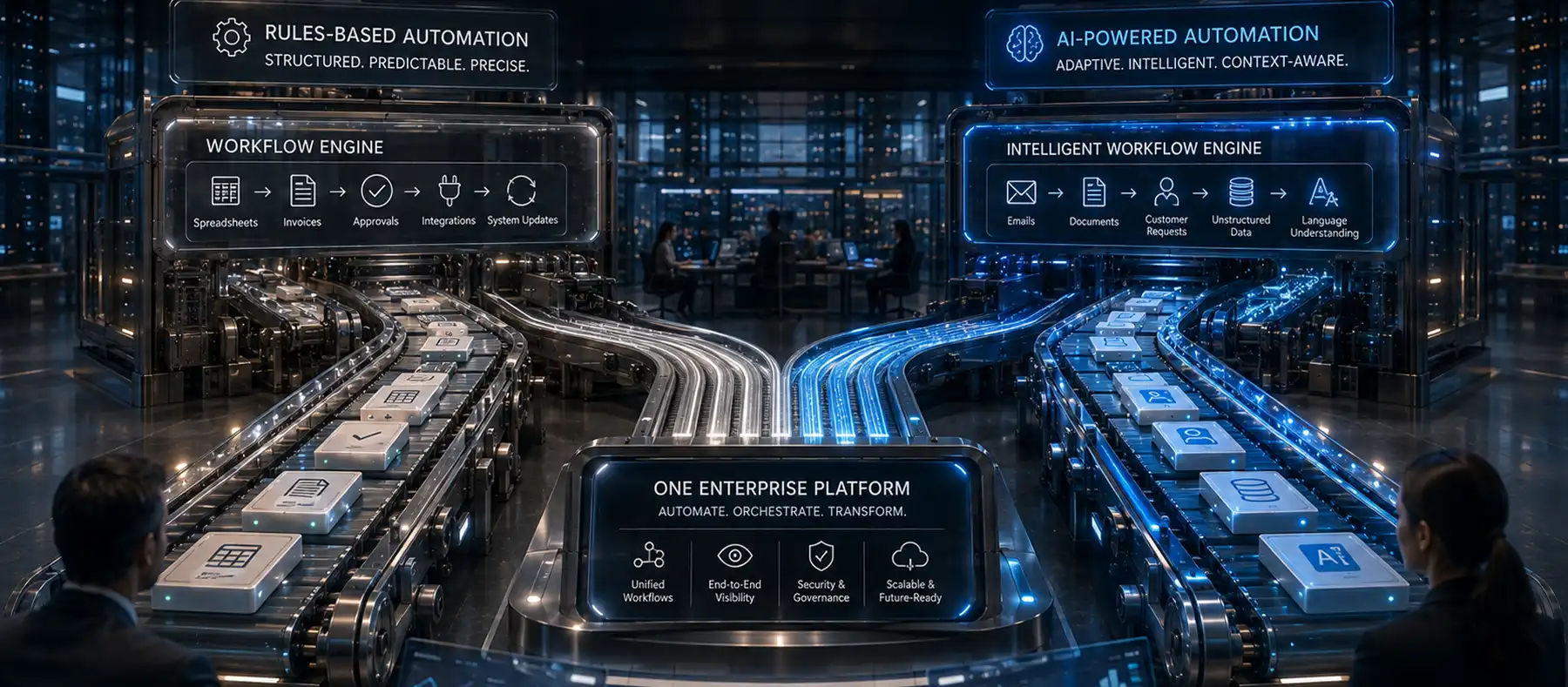
Traditional automation follows fixed, predefined rules: if X happens, do Y. It's fast, cheap to run, and completely predictable — the same input always produces the same output. Its limitation is that it can't handle anything it wasn't explicitly programmed for.
AI automation is different. It handles ambiguous, variable, language-heavy inputs — reading a document that doesn't follow a fixed template, understanding a request written in plain English, classifying messy data. But it's probabilistic: it can be confidently wrong, so it needs oversight, and it costs more to build and run.
When traditional automation is better
When a task has clear rules and clean, predictable inputs, traditional automation wins — and it's not close. Scheduled data transfers, fixed calculations, structured system-to-system exchange, and repetitive rule-based steps are all faster, cheaper, and more reliable as plain automation.
If two systems need to swap structured data, you don't need a model to interpret it — you need an integration. Reaching for AI here adds cost and uncertainty for no benefit. Not every process needs intelligence; many just need reliable rules.
When AI automation is worth it
AI earns its higher cost and oversight when the inputs vary too much for fixed rules. Reading invoices from hundreds of different suppliers, understanding free-text customer requests, extracting data from documents that don't follow a template, classifying unstructured information — these defeat rule-based automation but suit AI well.
The test: if you find yourself trying to write endless rules to cover every variation and still missing cases, that's a sign the problem needs AI's flexibility. If a handful of clear rules cover it, it doesn't.
The best systems combine both
In practice, the strongest solutions use both. Traditional automation handles the predictable steps, AI handles the ambiguous ones, and people approve what matters. A document workflow might use AI to read and extract from varied documents, rules-based validation to check the data, and automation to move it into the right system — each part doing what it does best.
The skill isn't choosing one approach for everything; it's matching each part of a process to the right tool.
A simple way to decide
For any process, ask: are the inputs clear and predictable, or varied and ambiguous? Clear and predictable → traditional automation, almost always. Varied and ambiguous → AI is likely worth it. Mixed → combine them. And weigh cost: traditional automation has no per-use model cost and is cheaper to run, so AI should only take over where it removes work that rules genuinely can't.
KBA Systems helps businesses make exactly this call — recommending rules-based automation where it fits, AI where it's justified, and building the right combination into existing systems.
Frequently Asked Questions
What is the difference between AI and traditional automation?
Traditional automation follows fixed, predefined rules and is completely predictable, but can't handle inputs it wasn't programmed for. AI automation handles ambiguous, variable, language-heavy inputs, but is probabilistic and needs oversight. They suit different kinds of work.
When is traditional automation the better choice?
When a task has clear rules and clean, predictable inputs — scheduled data transfers, fixed calculations, structured system-to-system exchange. It's faster, cheaper, and more reliable than AI for this work, and adding AI just introduces cost and uncertainty.
When is AI automation worth it?
When inputs vary too much for fixed rules — reading varied documents, understanding free-text requests, classifying messy data. AI earns its higher cost and oversight needs when flexibility with ambiguous inputs is the whole point.
Can you combine AI and traditional automation?
Yes, and the best systems usually do. Traditional automation handles the predictable steps, AI handles the ambiguous ones, and humans approve what matters. Matching each part of a process to the right approach beats forcing everything through one.
Which is cheaper, AI or traditional automation?
Traditional automation is usually cheaper to build and run for suitable tasks, with no per-use model cost. AI costs more and adds ongoing oversight, so it's only the cheaper option overall when it removes work that rules-based automation simply can't.
Not sure whether a process needs AI or plain automation?
KBA Systems can review your workflows and recommend the right approach for each — rules-based automation, AI, or a combination — and build it into your existing systems.
Related Article

How AI Can Improve Customer Service Without Replacing Your Support Team
How AI can improve customer service without replacing your support team — triage, drafting, knowledge retrieval and where human agents stay essential.

Human-in-the-Loop AI: Why Businesses Should Never Automate Everything
Human-in-the-loop AI explained — why businesses should never automate everything, where human oversight matters most, and how to design review into AI systems.

Stop Building Apps. Start Architecting Intelligent Systems.
Whether you need to modernize legacy infrastructure or build custom AI agents from scratch, our elite engineering pods are ready to design your competitive edge. Let’s map out your transition.
