

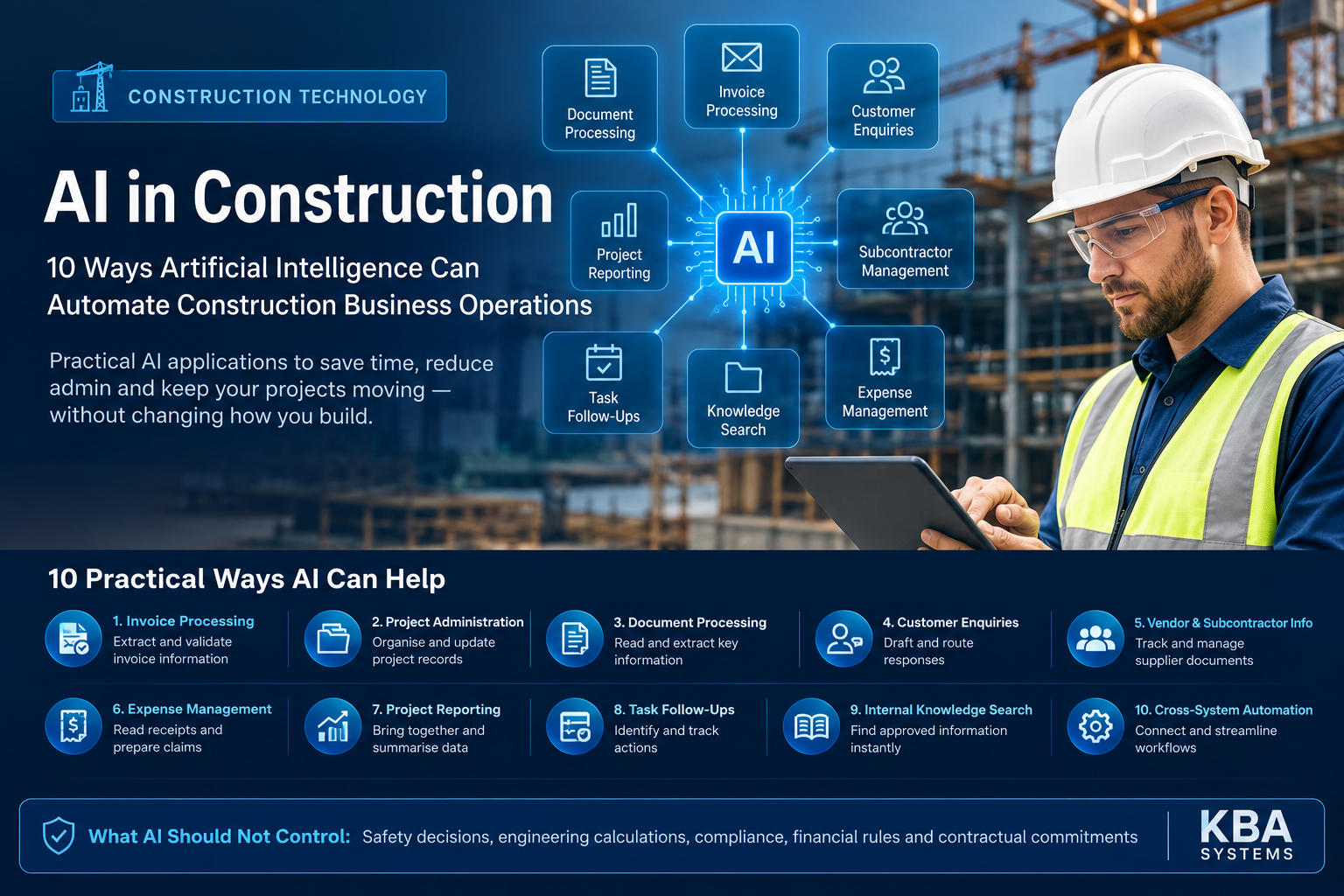
AI in Construction: 10 Ways Artificial Intelligence Can Automate Construction Business Operations
When people hear "AI in construction," they often picture robots, autonomous machinery or futuristic building sites.
But for many construction businesses, one of the most practical opportunities for AI is much closer to the office.
Construction companies deal with large amounts of administration: invoices, project paperwork, subcontractor information, customer enquiries, expenses, reports and tasks spread across different systems.
AI can help reduce some of this repetitive work without changing how the actual construction work is performed.
The important point is knowing where AI helps and where it should not be used.
This guide covers 10 practical ways AI can support construction business operations, how it can connect with existing software and which decisions should remain firmly with qualified people.
What Does AI Mean for Construction Business Operations?
In this article, we're talking about the business and administrative side of running a construction company.
That includes areas such as:
- Finance and invoices
- Project administration
- Documents
- Customer communication
- Supplier and subcontractor information
- Reporting
- Internal knowledge
- Workflow coordination
We're not talking about replacing engineers, site managers or skilled workers.
In these business workflows, AI can help read documents and messages, understand requests, extract information, prepare summaries and move information between approved systems.
People remain responsible for decisions that matter.
How Can AI Connect to Existing Construction Software?
Introducing AI doesn't automatically mean replacing your project-management software, accounting system, CRM or other business applications.
AI capabilities can often connect with existing systems through controlled APIs and integrations.
A simplified architecture might look like:
Project Management + Finance + CRM + Email + Documents
↓
Secure Integration Layer
↓
AI Capability + Business Rules
↓
Human Review / Approval
↓
Existing Business Systems
This is important because AI should be treated as part of the overall software architecture rather than as a standalone tool with unrestricted access to company systems.
10 Ways AI Can Automate Construction Business Operations
1. Invoice Processing
Construction companies may receive invoices from material suppliers, subcontractors, equipment providers and other vendors.
Processing these manually can involve reading the invoice, entering information, finding the supplier, checking purchase-order details and sending it for approval.
AI can help read incoming invoices and extract information such as:
- Supplier
- Invoice number
- Date
- Amount
- Tax
- Purchase-order reference
Traditional software can then validate this information against company records.
If something is missing or unusual, the invoice can be sent to a person for review.
The important financial controls remain in place.
AI reads. Software validates. People approve.
2. Project Administration
A significant part of project management involves administration.
Project teams need to organise documents, maintain records, prepare updates and make sure information stays current across different systems.
AI can assist by preparing draft updates, organising information and helping move routine information between approved systems.
This can reduce administrative work for project managers while keeping decisions about priorities, deadlines, resources and client commitments with the responsible people.
3. Document Processing
Construction projects generate large numbers of documents.
These can include:
- Contracts
- Variation documents
- Certificates
- Delivery notes
- Compliance documents
- Project reports
- Drawing registers
- Supplier documents
AI can help read these documents, extract important information and make it easier for employees to find what they need.
However, extracted information should be treated as information to verify — particularly when it has contractual, financial, safety or compliance implications.
AI can assist with reading the document.
It should not automatically decide what the document legally or contractually means.
4. Customer Enquiries
Customer and client enquiries can take significant time to manage.
AI can help read incoming messages, identify what the customer is asking, retrieve relevant approved information and prepare a draft response.
Routine enquiries can then be handled more efficiently.
More sensitive requests can be routed to the appropriate employee.
For example, a simple request for a project update may be suitable for an AI-assisted response.
A contractual dispute or significant project change should go directly to the responsible person.
5. Vendor and Subcontractor Information
Construction businesses often need to maintain large amounts of information about suppliers and subcontractors.
This might include:
- Contact information
- Insurance documents
- Certifications
- Qualifications
- Compliance documents
- Expiry dates
AI and automation can help organise this information, identify missing documents and flag records that may require attention.
The decision about whether a supplier or subcontractor is suitable should remain with the responsible team.
AI helps organise the information.
People make the decision.
6. Expense Management
Site teams and employees may generate receipts, expense claims and other financial documents.
AI can help read receipts, extract information and prepare expense records for review.
Traditional software can then apply company policies and financial rules.
Anything unusual can be flagged for a person to check.
Final approval and accounting should remain within the company's established finance process.
7. Project Reporting
Preparing project and management reports often requires information from several different systems.
AI can help bring approved information together and prepare a draft summary covering areas such as:
- Project progress
- Outstanding items
- Upcoming milestones
- Tasks requiring attention
- Operational updates
However, important figures should come directly from the company's trusted business systems.
AI can help summarise and explain the information.
It should not invent or independently calculate critical project or financial figures.
8. Task Follow-Ups
Project managers can spend a significant amount of time checking what is overdue, who is responsible and what needs attention.
AI-assisted workflows can help:
- Identify overdue tasks
- Prepare reminders
- Highlight tasks requiring attention
- Notify responsible people
- Prepare project-status summaries
The project manager still decides priorities and what action should be taken.
The technology helps reduce the administrative work around tracking.
9. Internal Knowledge Search
Construction businesses build up valuable knowledge over many years.
It may exist across:
- Policies
- Procedures
- Project documents
- Method documentation
- Internal manuals
- Previous project information
- Shared drives
Employees can spend a lot of time trying to find the right information.
An AI-powered knowledge assistant can allow employees to ask questions in normal language and search approved company information.
Where possible, answers should reference their original sources so employees can verify important information.
Permissions are also essential.
An employee should not be able to access information through AI that they would not normally have permission to see.
10. Cross-System Workflow Automation
This can be one of the most useful applications because construction administration rarely happens inside one system.
A typical workflow might involve:
Email → CRM → Project Management → Finance → Documents → Notifications
Consider a client emailing to request a project variation.
An AI-enabled workflow could potentially:
- Read and understand the request
- Identify the customer
- Find the relevant project
- Prepare a draft task
- Notify the project manager
- Prepare a draft acknowledgement
- Wait for human approval before important actions
The important part is how the technologies work together:
AI understands the request.
APIs connect the systems.
Business rules control the workflow.
People approve important actions.
This can provide much more business value than simply adding a chatbot to a website.
Which Construction Software Can AI Work With?
AI becomes more useful when it connects with the systems a construction company already uses.
Project Management Software
AI can assist with project updates, task tracking, document organisation and reporting.
Accounting and Finance Systems
AI can help process invoices and expenses while calculations, accounting rules and approvals remain in the finance system.
CRM
AI can help organise enquiries, prepare follow-ups and assist with customer information.
Incoming emails can be classified, summarised and routed to the appropriate workflow.
Document Systems
AI can help extract and organise information from contracts, certificates, invoices and other documents.
Customer Portals
AI-assisted capabilities can help customers locate approved information or prepare requests.
Employee Systems
AI can assist with onboarding administration, document search and common internal questions.
KBA Systems has experience building construction-focused business platforms.
A practical pattern is often integration rather than replacement: use AI and automation around existing systems where they provide value while keeping reliable business software in place.
What Should AI NOT Control in Construction?
This is one of the most important considerations.
Construction involves safety, engineering, legal and financial responsibilities.
Some decisions should remain with qualified professionals and established systems.
Safety-Critical Decisions
AI can help organise safety-related information, but decisions affecting worker or public safety should remain with appropriately qualified and responsible people.
Engineering Calculations and Decisions
Structural, load, design and other engineering calculations should use appropriate validated engineering methods and software and be reviewed by qualified professionals where required.
AI can assist with information retrieval or administrative tasks, but it should not replace professional engineering responsibility.
Compliance and Regulatory Decisions
AI can help locate and summarise regulatory information.
Final interpretation, compliance decisions and accountability should remain with appropriately qualified people.
Financial Calculations and Payments
Important financial calculations, valuations, payment rules and approvals should remain within deterministic finance systems and authorised business processes.
Contractual Decisions
AI may help find relevant information within contracts.
However, contractual interpretation, claims, variations and commitments should remain with appropriately qualified and authorised people.
A useful principle is:
AI can help with the administration around construction. Qualified people and reliable systems remain responsible for safety, engineering, compliance, contracts and money.
How Should Construction Businesses Start With AI?
Don't begin by trying to automate the whole company.
Start with one clear business problem.
Look for a process that is:
- Repetitive
- Time-consuming
- High volume
- Well understood
- Low enough risk for a controlled first implementation
Invoice processing, document search or internal knowledge retrieval may be practical areas to evaluate.
Document how the process works today.
Then ask:
Which steps involve reading?
AI may help.
Which steps follow clear rules?
Traditional automation may be better.
Which steps involve moving data between systems?
Use APIs and integrations.
Which steps involve important decisions?
Keep people involved.
Build a focused first version and measure it against the existing process.
Useful measures might include:
- Processing time
- Manual work
- Response time
- Error and rework rates
- Number of exceptions
- Employee adoption
Then decide whether expanding the automation makes business sense.
And be willing to conclude that a particular process doesn't need AI.
Sometimes straightforward software automation or an API integration is cheaper, simpler and more reliable.
The objective isn't to add AI everywhere.
The objective is to improve how the construction business operates.
Frequently Asked Questions
How Can AI Help a Construction Business?
AI can help with administrative and operational tasks such as invoice processing, document handling, customer enquiries, supplier information, project reporting, task follow-ups and internal knowledge search.
The aim is to reduce repetitive work while keeping important decisions with people.
Does AI in Construction Mean Robots and Autonomous Machinery?
Not necessarily.
AI in construction can also mean using software to improve business operations such as finance, project administration, documents, reporting and customer service.
This article focuses specifically on those operational applications.
Does AI Replace Construction Project Management or Accounting Software?
Usually, it doesn't need to.
AI capabilities can often connect with existing project-management, finance, CRM, email and document systems through controlled integrations.
What Should AI Never Control on a Construction Project?
Safety-critical decisions, professional engineering decisions, important compliance interpretations, significant financial decisions and contractual commitments should remain with appropriately qualified and authorised people.
Where Should a Construction Company Start With AI?
Start with one well-understood administrative problem where repetitive work is creating a clear burden.
Evaluate whether AI, traditional automation or better system integration is the most appropriate solution, build a focused first version and measure the results before expanding.
Looking to Reduce Construction Administration?
If administration is taking more time than it should across your projects, KBA Systems can review your existing construction software, workflows and integrations.
We can help identify where AI and automation could realistically reduce repetitive work, where better system integration may be enough and where qualified people should remain firmly in control.

Stop Building Apps. Start Architecting Intelligent Systems.
Whether you need to modernize legacy infrastructure or build custom AI agents from scratch, our elite engineering pods are ready to design your competitive edge. Let’s map out your transition.
